
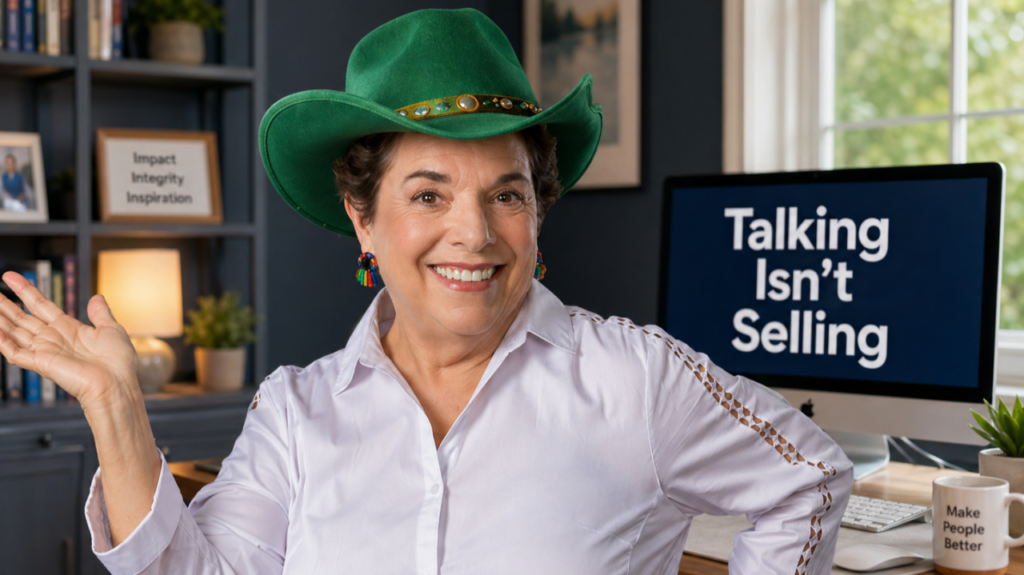
When experts move into business ownership, they often assume they already know how to have a sales conversation.
After all, they know what they do.
They know their field. They know their process. They know how to explain what they do.
And that is often the problem.
Recently, I spoke with a man in IT consulting who had just started his own business.
I admired his knowledge, experience, and strong track record. Within minutes, he walked me through:
- the systems he implemented
- the industries he worked with
- the technical issues he solved
- his process
- his packages
He spoke for nearly ten minutes without stopping.
At the end, he asked: “So… what do you think?”
I recall saying to myself, “I know exactly what you do, but you know nothing about me.”
It felt transactional and not relational.
That is the difference between talking about what you do and having a sales conversation.
Talking about what you do is descriptive.
It focuses on:
- the problems you solve
- the actions you take
- your credentials
- your methods
- your services
➡️The focus is on you.
A sales conversation is different.
It starts with curiosity and interest.
➡️It focuses on the prospect.
- You ask questions.
- You clarify what they mean.
- You listen for what is said — and what is not said.
- You go deeper.
- You help them uncover problems they may not yet recognize.
Someone might say:
“We need more leads.”
But when you ask more questions, you discover:
- They already have leads
- Their messaging is confusing
- They are attracting the wrong people
- Their profile is not converting
- They are losing people during conversations
Each is a very different problem.
And requires a very different solution.
This is why so many experts lose opportunities without realizing it.
They think the prospect was unqualified. They think the lead was not serious. They think the timing was wrong.
And sometimes that is true.
But often, the prospect simply did not feel understood. The underlying problem was not identified. No meaningful relationship was established.
Most people do not buy because they heard a good explanation.
They buy because they feel:
- Seen
- Understood
- Supported
- Clear
- Confident
That is what great sales conversations create.
And that is why they do not feel pushy or salesy.
THEY FEEL HELPFUL!
Relationship Builder
One of the fastest ways to build trust is to help someone articulate a problem more clearly than they could on their own.
When people feel understood, they relax.
They stop defending. They stop performing. They stop trying to sound smart.
And that is usually when the real conversation begins.
The C2C Tweak
This week, pay attention to how quickly you shift into explaining.
When someone asks what you do, notice whether you immediately start describing your process, services, and expertise.
Instead, pause.
Ask a question first.
Try:
- “What made you ask?”
- “What is happening on your side?”
- “What have you already tried?”
- “What do you think is really causing the issue?”
You do not need to prove yourself so quickly.
You do not need to explain everything.
You need to understand.
That is what creates connection.
And connection is what leads to clients.
Let’s Talk
If your conversations feel too much like explaining, presenting, or proving… and not enough like connecting, discovering, and converting… let’s talk.
You do not need more scripts.
You need better questions.
To your sales success,
Nancy Zare, Ph.D.
Helping Experts Become Confident Business Owners