You Probably Need Fewer Clients Than You Think
An IT consultant said something to me recently that I haven’t stopped thinking about.
“I think I need more visibility.”
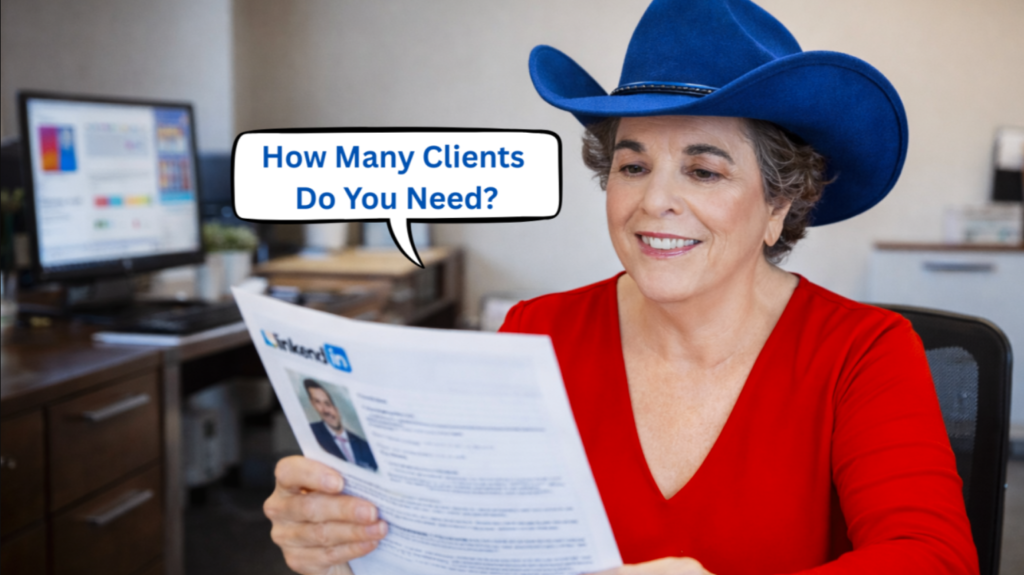
So I asked him: “How many clients do you actually want this year?”
He paused.
Then laughed.
Because he didn’t know.
Not really.
Like many experts-turned-business owners, he had been chasing a feeling: More visibility. More followers. More engagement. More activity.
But no actual number.
So we slowed it down and did simple math.
He wanted 10 new clients this year.
His closing rate was about 25%. Meaning: For every 4 qualified conversations, 1 became a client.
So what did he actually need? About 40 strong prospect conversations over an entire year.
Forty.
That’s less than one per week.
Not 40,000 followers. Not viral posts. Not daily content exhaustion.
Just the right conversations with the right people.
That realization changed everything. Because suddenly LinkedIn stopped feeling like a performance… and started feeling like relationship-building.
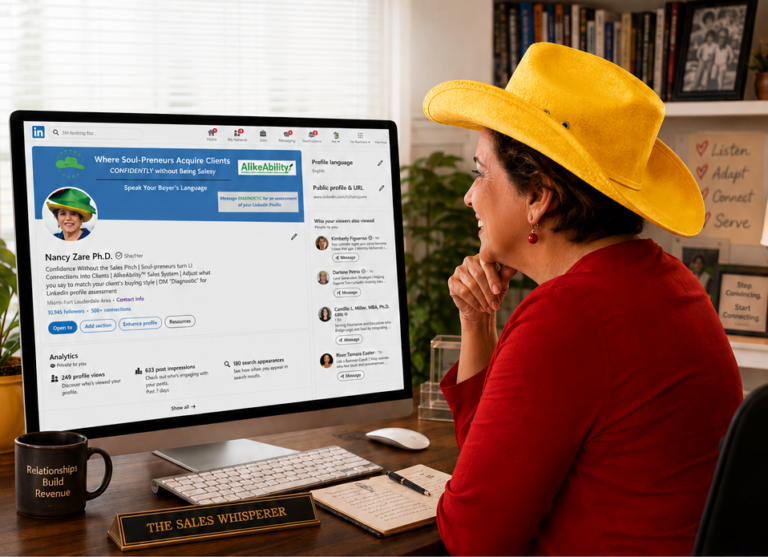
And this is where your profile matters more than most people realize.
Statistically, you have about 4 seconds when someone lands on your profile. Four seconds for someone to decide: “Let me look around.” —or— “I’m leaving.”
That means your profile is not a résumé. It’s a positioning tool.
It should immediately communicate: → who you help → what problem you solve → why your approach is different → why someone should trust you.
Most profiles are too broad. Too generic. Too focused on credentials instead of connection.
But buyers are rarely looking for “the best.” They’re looking for: → resonance → relevance → relief → someone who understands them
Your profile should feel like: “You get me.” “We’re alike.” That is the heart of the AlikeAbility™ System.
People naturally trust, connect with, and respond to people who feel psychologically familiar to them.
Not identical. Familiar.
For example:
A security-oriented person wants to feel trust, steadiness, and reliability. An action-oriented person wants momentum, directness, and possibility. A relationship-oriented person wants warmth, connection, and sincerity. An evidence-oriented person wants logic, structure, and credibility.
Different people look for different emotional signals.
Yet most LinkedIn profiles sound generic because they try to appeal to everyone equally.
The strongest profiles create psychological familiarity by using the language of their ideal buyer.
They help the right person quietly think:
“This person understands my world.” “This person speaks my language.” “This feels easy.” “This feels safe.” “This feels aligned.”
That’s not manipulation. That’s resonance. And resonance is what transforms a LinkedIn profile from informational… to relational.
From visibility… to trust.
From connection… to client.
C2C Tweak This Week
Open your LinkedIn profile.
Now imagine your ideal client landing there for the first time.
Would they immediately think: “This person understands someone like me.”
Or would they have to work too hard to figure it out?
Clarity builds trust faster than cleverness.
Read your headline.
What word or phrase can you add that would appeal to your ideal client?
Relationship Building Reminder
You do not need to impress everyone.
You need enough trust-building conversations with the right people.
A meaningful comment. A thoughtful DM. A profile that speaks directly to someone’s real problem.
That’s how relationships become clients.
Slowly. Naturally. Consistently.
Ready for Your Profile to Actually Work?
If your profile feels vague, outdated, too corporate, or disconnected from the clients you truly want…
Join us inside the LinkedIn Profile Lab on Thursday May 28.
https://nancyzare.com/profile-lab
This is hands-on 90-minute workshop for experts turned business owners to optimize your LinkedIn presence so it creates real conversations — not just passive visibility.
Because you probably don’t need more followers.
You need more resonance.
To your sales success,
Nancy Zare, Ph.D., Helping Experts become Confident Business Owners